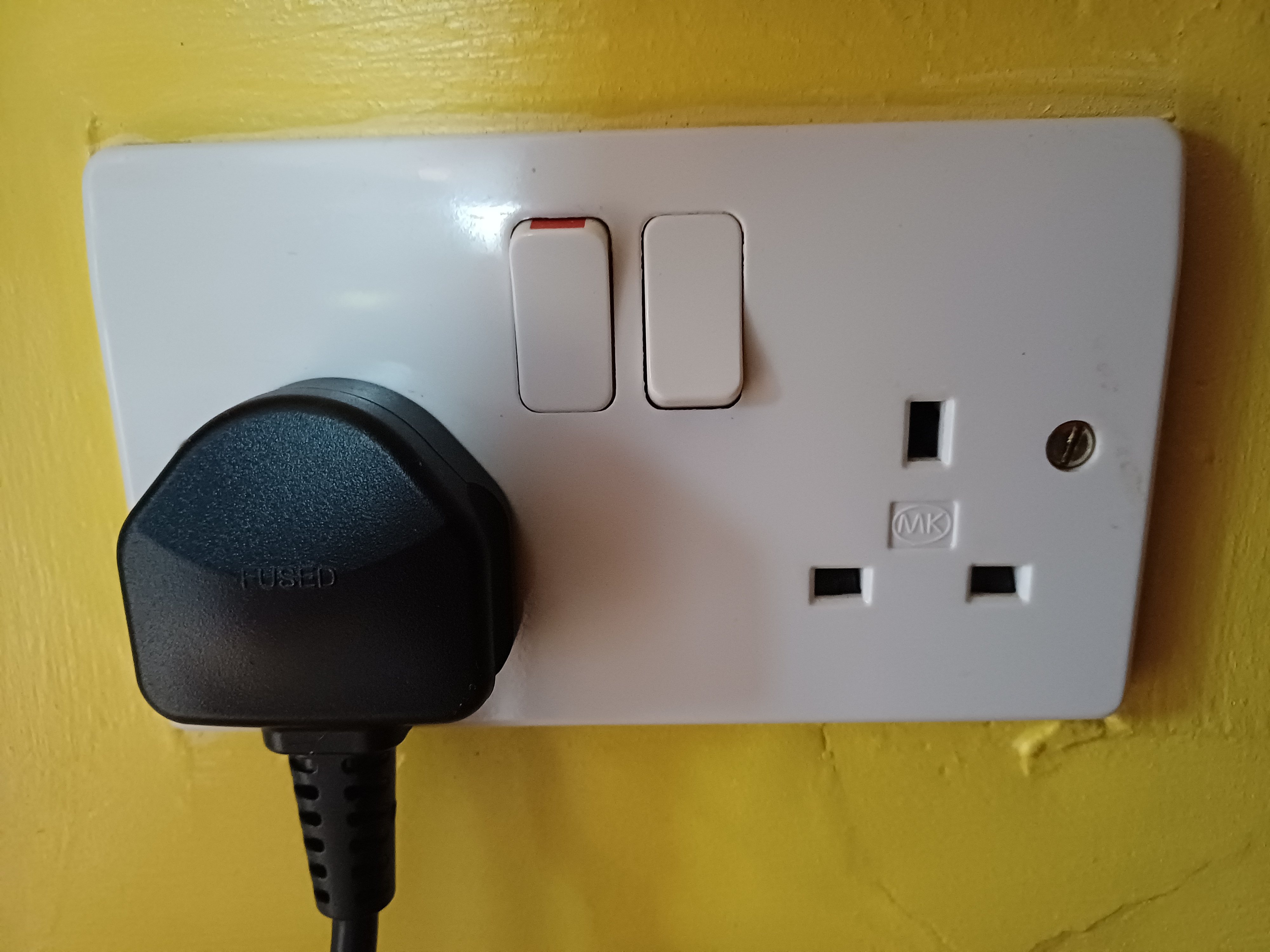
Did you know that the UK Government is planning to allow you to install portable solar panels that you plug into a standard 3-pin socket? [from 27 August 2026].
What are plug-in solar panels?
Small-scale solar panels that you can install outside on a balcony, fence, garden shed or garden. These can be plugged into a standard 3-pin plug without needing any additional wiring or pay an electrician. The panels will supply electricity to your house, with any surplus exported to the grid.
What is changing?
At present plug-in solar panels are not permitted under electrical safety regulations. However, other countries such as Germany allow “solar balconies”, with over 2 million sold.
In April 2026 the UK’s wiring regulations were updated (BS7671) and there are plans to create a BSI Product Standard to enable plug-in panels to be legally sold in the UK.
The maximum power that will be permitted is 800 Watts.
Planning permission will not normally be required unless you live in a listed building or in a conservation area. People renting property should be able to participate but you might need to check with your landlord. The panels are portable and therefore you can take them with you if you move home.
Where can I buy plug-in solar panels?
Retailers such as Amazon, Lidl, Sainsbury (Argos) and Iceland have expressed an interest in selling them. They will become a mass market consumer item that you can order to your home.
Please note that at present it is illegal to install these in the UK.
How much do they cost?
Each retailer will determine what cost they sell out. Initially a cost of £500 has been suggested including a micro-inverter (check) and brackets that can clamp them to railings. You may need to buy an extension cable and other fixing brackets.
You may also want to buy a small battery to store the surplus generated during the day to use in the evening. A 1 to 2 kWh battery may cost in the order of £500+.
Note that purchase costs are very uncertain, and may come down as the market grows, as this is a brand-new market for the UK.
How much energy can they produce?
800-Watt solar panels can theoretically generate 820 kWh of electricity in a year in London. This is assuming that they face due South, there is no shade and are an optimum tilt of 30-40 degrees.
The average household uses 2,900 kWh per year, so this equates to 28% of your electricity consumption.
A house further north in Scotland might produce 80-90% of this. Panels facing east or west would produce around 70% of this amount. Likewise, panels placed vertically would produce around 70% and therefore vertical panels facing east or west would only produce 70% of 70% = 49%. However, you could have two panels (and two micro-inverters), one facing east, one west to maximise your use of the solar generated.
Any shading, for example from buildings or trees, will further reduce your generation.
How much would I use?
This is hard to judge and varies between households. Your panels will generate between 0 and 800 Watts. Every house has a continuous “standby” use of electricity in the order of 100-200 Watts, but the likelihood is that you won’t be using 800 Watts during a sunny summer’s day. So, some of the electricity generated will be exported to the grid.
You can overcome this by investing in a small battery which will store the surplus electricity generated during the day enabling you to use it in the evening and overnight.
What is the payback?
|
Scenario 1: Good location |
without battery |
with battery
|
|
Purchase cost |
£500 |
£1,000 |
|
Units generated |
820 |
820 |
|
Units used in your home |
574 (70%)* |
820 (100%) |
|
Savings @25p/unit |
£143 |
£205 |
|
Payback period |
3.5 years |
4.9 years |
|
15-year net saving |
£1,645 |
£2,075 |
‘* The theoretical optimum payback, if you used 100% of the electricity in your home, would be 2.4 years and £2,575 saving over 15 years. Here I assume 70% use in your home.
|
Scenario 2: some shade, not optimally sited |
without battery |
with battery
|
|
Purchase cost |
£500 |
£1,000 |
|
Units generated |
410 (50%) |
410 (50%) |
|
Units used in your home |
328 (80%)* |
410 (100%) |
|
Savings @25p/unit |
£82 |
£102 |
|
Payback period |
6.1 years |
9.8 years |
|
15-year net saving |
£730 |
£530 |
‘* Assuming 80% used in your home; higher than scenario 1 because you are rarely going to achieve the maximum 800 Watts generated.
Note that the panels should come with a 25-year guarantee, but the micro-inverter may require to be replaced after 10+ years at a cost of around £100.
Will this make a difference?
If 3 million households installed 800 Watt panels, producing 700 units each per year this could generate 2.1TWh of electricity, equivalent to nearly 1% of the UK’s annual electricity consumption.
It will also help to engage a much wider group of householders to directly participate, and benefit from, the clean energy revolution.
The UK Government is planning to provide free plug-in panels under their Warm Homes Plan in partnership with Local Authorities (will apply to England and Wales, whilst Scotland operates a different grant regime). The rules are yet to be finalised but is possible that those on low incomes or receiving certain benefits will be eligible.
Fixed v Plug-in Solar Panels
An alternative option is to buy ‘traditional’ solar panels attached to your roof. A 4kW system costs around £6,000, or £10,000 with a battery. This is considerably more expensive than the plug-in solar panels because of its larger size plus the cost of scaffolding, wiring and installation. Fixed solar panels therefore have a longer payback than plug-in panels.
However, plug-in solar panels will be restricted to a maximum of 800 Watts, so if you have the right roof then there is still a good case to install fixed panels. Although the payback period will be longer, the overall savings over 15 years will be much higher as you save on your electricity bill and can receive a solar export tariff. Of course, you could install plug-in panels and fixed panels to your home…..
Conclusions
Plug-in solar panels should be a good investment for renters and homeowners who have suitable outdoor space to site them facing between south-east and south-west. The payback period might vary between 3.5 and 10 years depending on site specific factors.
If you have a suitable location to site your panels, an existing outside plug, reasonably modern electrics and circuit board and you tend to be at home during the day to use electricity then buy as soon as they are available.
However, for many it might be sensible not to rush in to purchase. Prices may come down, the range of compatible batteries and controls may develop quickly and the Government may introduce schemes to subsidise the purchase cost for certain homeowners and tenants.
---------------------------------------------------------------------------------------------------------------------------------------------------------------------------------------------------------------
If you like this blog, please share with your friends and on social media.
Stay Connected and Discover More
I publish a monthly blog on climate solutions. You can access my existing blogs here, and can search by keyword or category. To join my mailing list email This email address is being protected from spambots. You need JavaScript enabled to view it. with the header “please subscribe”.
Connect on social media: LinkedIn, X, Facebook, Instagram, Bluesky
You might also enjoy Carbon Choices, on the common-sense solutions to our climate and nature crises. Available from Amazon or order a signed copy. I am donating one third of profits to rewilding projects.